
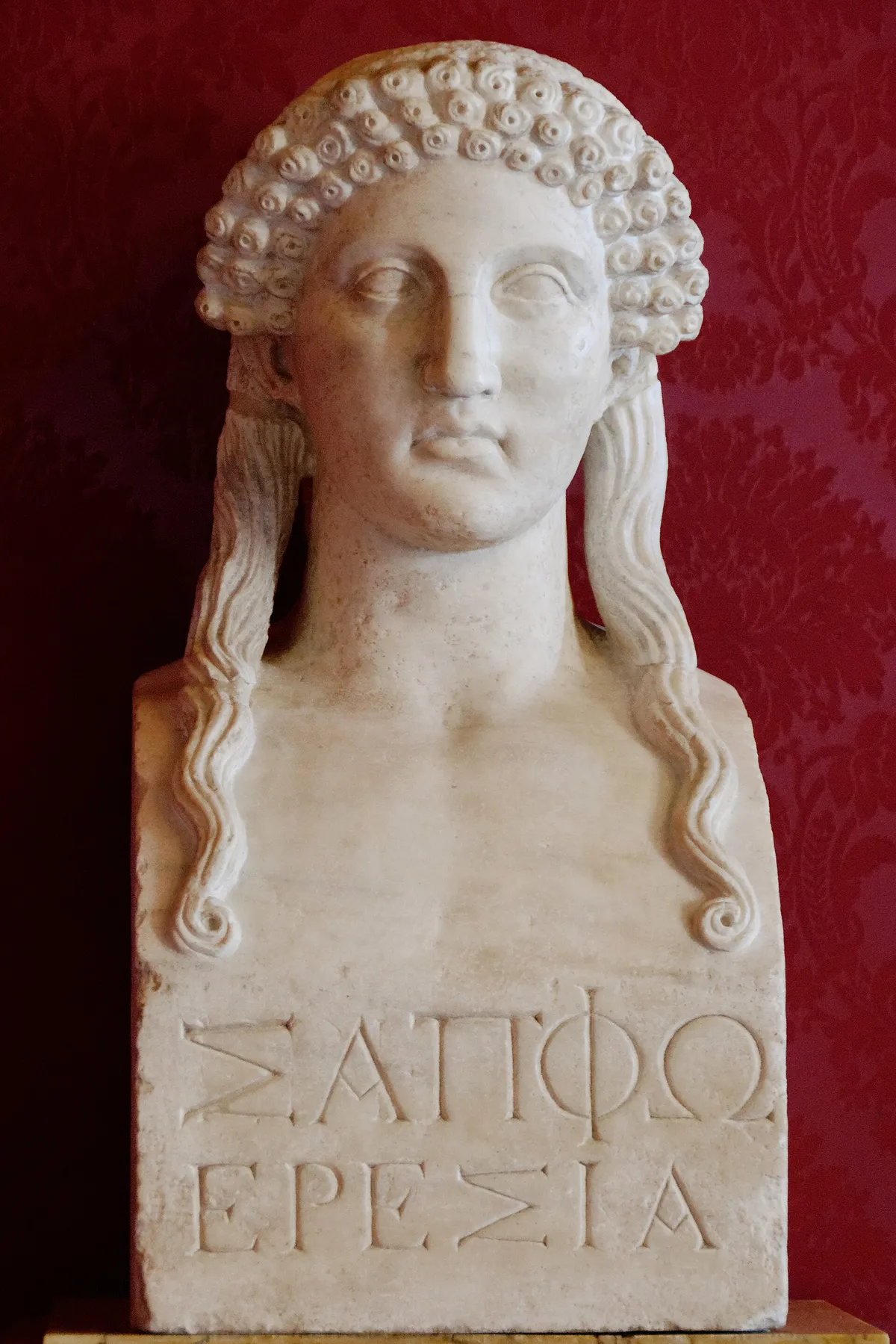
You might say “lesbian” every day, but did you know the word comes from a Greek island and a woman poet who lived 2,600 years ago?
Sappho of Lesbos
Sappho was born around 630 BC and lived on the Greek island of Lesbos.
- The English word lesbian comes from her home, Lesbos
- The word sapphic, describing love between women, comes from her name
Her poems were mostly about love and desire, and were written to be sung to music.
The “Tenth Muse”
In Greek myth there were nine Muses, goddesses of the arts. Sappho’s poetry was so admired that ancient writers called her the “Tenth Muse”, or simply “The Poetess”, as if there were no other.
She was also counted among the Nine Lyric Poets most highly esteemed by scholars in Alexandria.
Almost all lost
Sadly, most of Sappho’s poetry is lost.
- The ancient edition ran to at least eight books
- What survives is mostly fragments
- Only one poem, the Ode to Aphrodite, is certainly complete
In 2014, scholars published newly discovered papyri including the “Brothers Poem”, which mentions two of her brothers. Finding new Sappho more than two thousand years later thrilled scholars.
Was she a lesbian?
This is where it gets interesting. Classical Athenian comedies actually caricatured Sappho as a promiscuous woman who loved men. But today most scholars agree her poems clearly celebrate desire between women.
Some scholars also point out that ancient people didn’t have “homosexual” as an identity category, so Sappho herself might not even understand the modern question.
Most of her poems are lost, yet her name and her island became the world’s words for women who love women. That’s influence that has lasted 2,600 years.






💬 Comments