
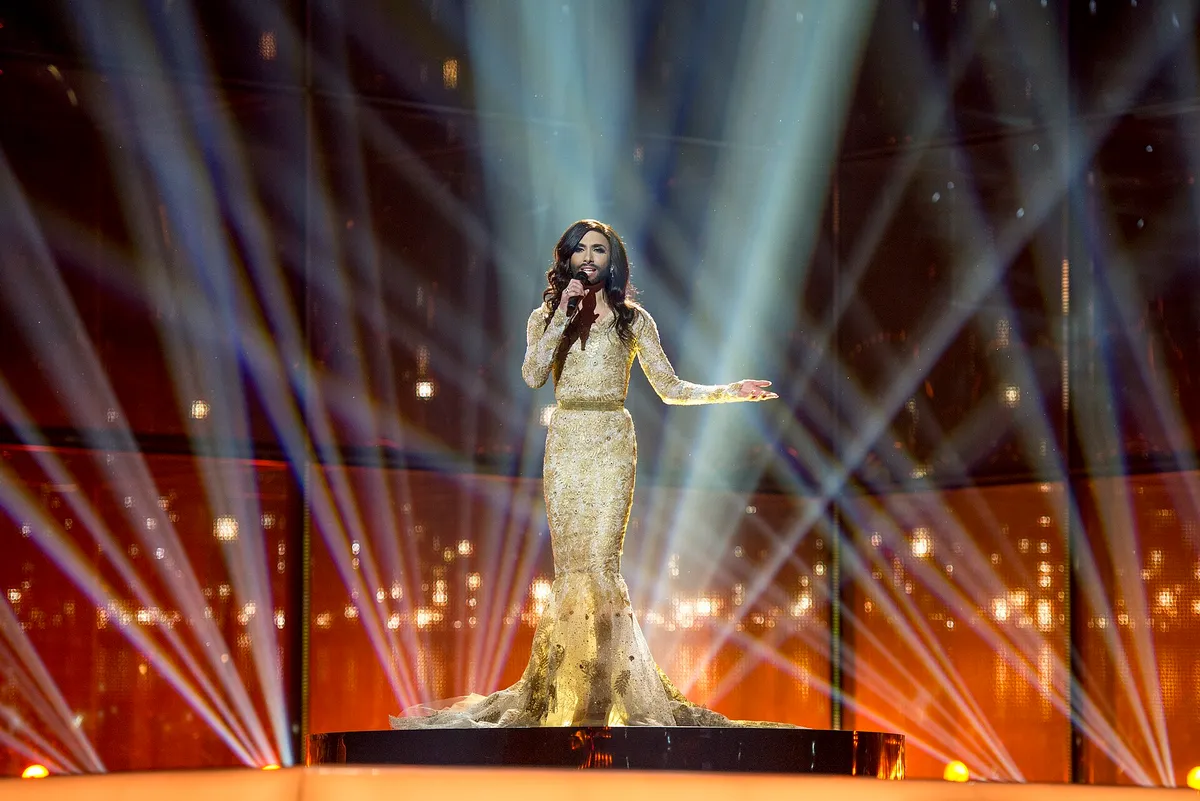
Eurovision has long been called “the gay World Cup”. Two of its winners stand out.
1998: Dana International’s “Diva”
Dana International is an Israeli pop singer born in 1969.
In 1998, she represented Israel in Birmingham with “Diva”, winning with 172 points and becoming Eurovision’s first transgender winner.
“Diva” reached number 11 in the UK and the top ten in Sweden, Belgium, Finland, Ireland and the Netherlands. At Eurovision’s 50th anniversary in 2005, it was chosen as one of the 14 best songs in the contest’s history.
The most absurd episode: after her win, Israeli religious authorities debated how she should pray in a synagogue. One rabbi concluded she should be counted as a man for a prayer quorum, but could not sing in front of the congregation because, under Orthodox rules, a woman’s singing voice shouldn’t be heard by men.
So she was treated as a man and a woman at the same time.
2014: bearded Conchita
Conchita Wurst is the drag persona of Austrian singer Thomas Neuwirth, best known for one thing: a full beard.
- She said the beard was “a statement to say that you can achieve anything, no matter who you are or how you look”
- “Wurst” means “sausage” in German, though she linked the name to the saying “it’s all the same to me”
Before the contest, petitions in Russia and Belarus demanded broadcasters edit out her performance, and a Russian politician called her the “pervert from Austria”.
Then, on 10 May 2014, Conchita sang “Rise Like a Phoenix” and won with 290 points. Holding up the trophy, she declared:
“We are unity and we are unstoppable!”
She went on to perform at the European Parliament and the United Nations Office in Vienna.
One had rabbis debating whether she counted as a man or a woman; the other had petitions to cut her from TV. Both won, and Eurovision got even more rainbow-coloured.





💬 Comments