
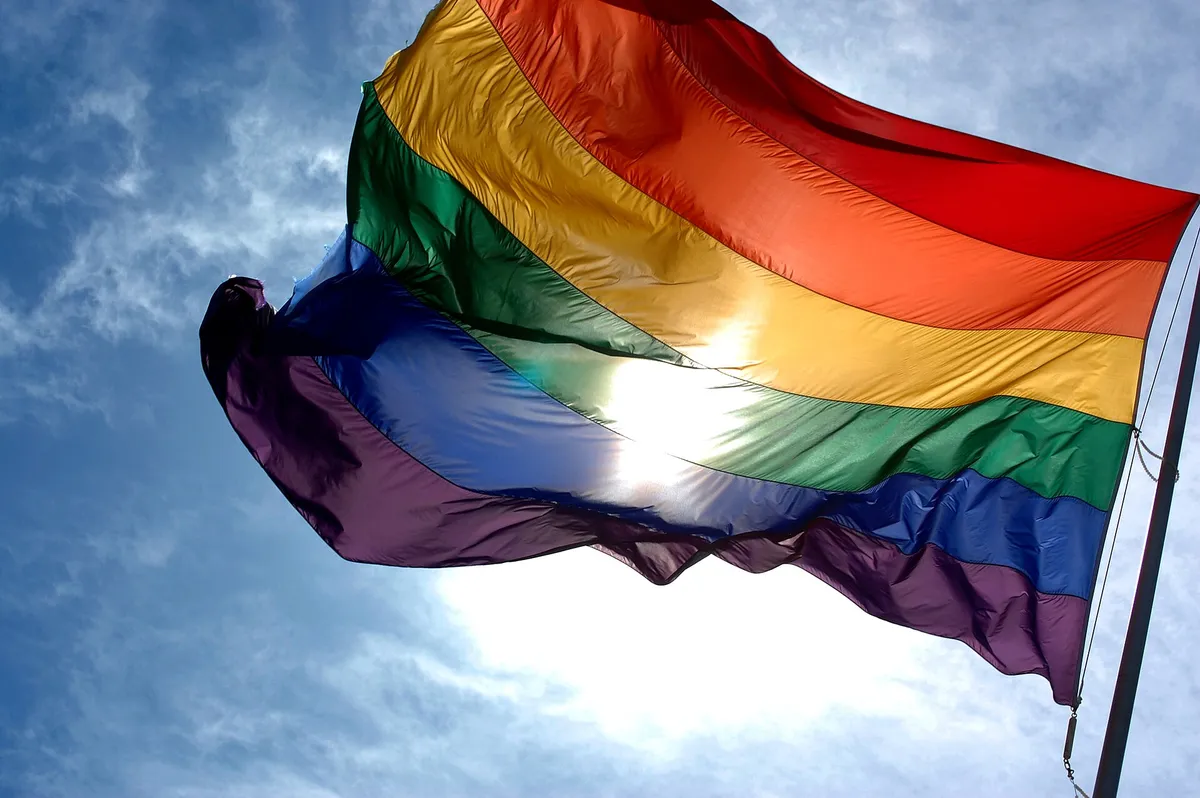
Today’s rainbow flag has six colours: red, orange, yellow, green, blue and violet. But when it was born, it had eight. Where did the other two go? The answer is very practical.
An army veteran who could sew
Gilbert Baker was born in Kansas in 1951. In the 1970s he served as an army medic in San Francisco, and after his discharge he stayed in the city as an openly gay man.
A fellow activist taught him to sew, and he started making banners for gay rights and anti-war marches. Around this time he met Harvey Milk and they became friends.
1978: the first rainbow flag
On 25 June 1978, the rainbow flag made by Baker and a collective of artists and activists first flew at the San Francisco Gay Freedom Day Parade. The original version had eight colours.
After Milk was assassinated that November, demand for the rainbow flag shot up.
Pink: too expensive
When Baker approached a flag company to mass-produce it, hot pink fabric was too rare and expensive, so pink was dropped.
Turquoise: the lamppost problem
Before the 1979 parade, organisers wanted to split the flag in two and hang the halves from lampposts on both sides of Market Street. Seven stripes don’t split evenly, so turquoise went too, leaving the six-stripe flag we still use today.
From an island kingdom to a museum
The flag’s later story is just as colourful:
- In 2003, for its 25th anniversary, Baker made a rainbow flag in Key West that stretched from the Gulf of Mexico to the Atlantic Ocean
- In 2004, activists sailed to Australia’s uninhabited Coral Sea Islands, raised the rainbow flag and declared the “Gay and Lesbian Kingdom of the Coral Sea Islands” to protest Australia’s refusal to recognise same-sex marriage. The “kingdom” dissolved only in 2017, when Australia legalised same-sex marriage
- In 2015, New York’s Museum of Modern Art acquired the rainbow flag, ranking it as important as the recycling symbol
Baker died in 2017. The two original 1978 flags were believed lost for over four decades, until in 2020 a remnant of one was found among his belongings.
A flag lost two colours, one to the budget and one to the lampposts. It still became one of the world’s best-known symbols, and a museum piece.






💬 Comments